How to Read and Evaluate a Tibetan Thangka Painting
A thangka is a Buddhist scroll painting made to support teaching, meditation and ritual, and it is read from the centre outwards: main figure first, then retinue, lineage above and protectors below. To evaluate one, look at drawing and proportion, quality of pigment and gold, the painting of the face and eyes, and honest signs of age and wear.
Updated
What is a thangka and what is it used for?
A thangka (Tibetan thang ka, roughly “something rolled out”) is a painting on textile, mounted in silk brocade so that it can be rolled up, carried and hung. Thangkas are made in Tibet, Nepal, Bhutan and wherever Himalayan Buddhism is practised. They usually depict a deity, a Buddha, a lama or teacher, or episodes from the history of Buddhism.
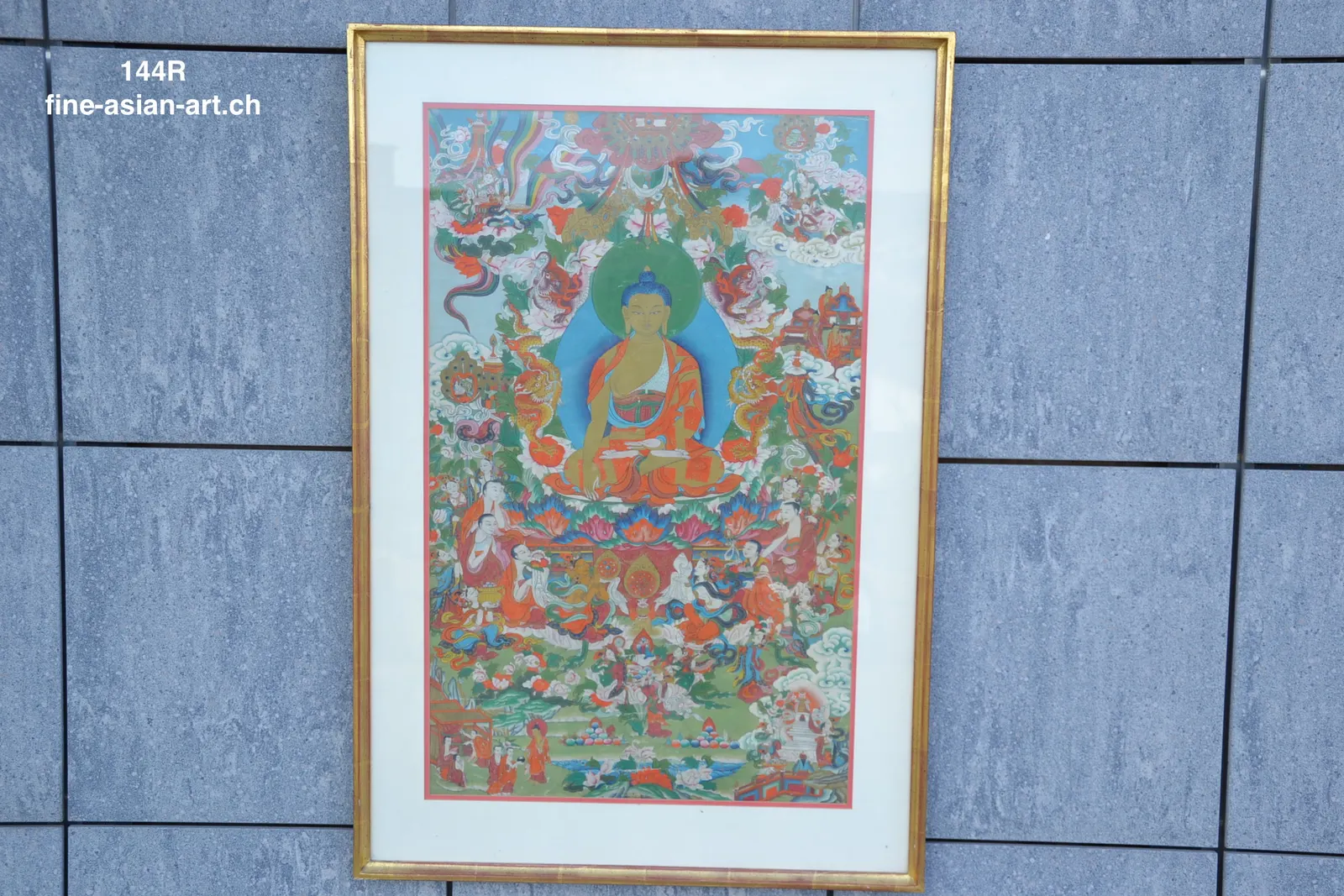
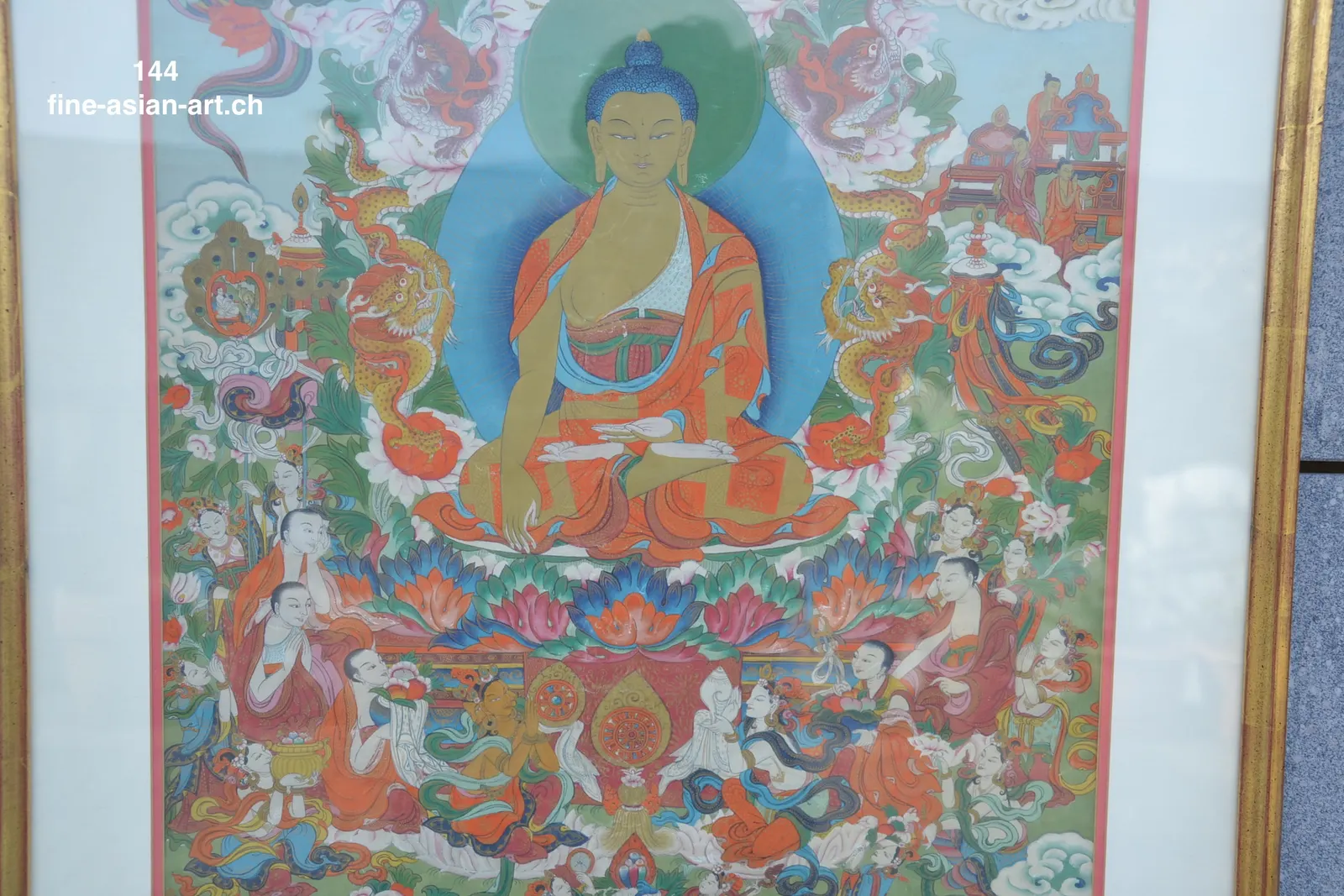
Their purpose is religious rather than decorative. A thangka can serve as a teaching aid, for example a narrative painting of the life of Shakyamuni Buddha; as a support for meditation, where the practitioner visualises the deity in precise detail; and as a ritual object, hung in a shrine room or temple and honoured with offerings. Our Buddha story thangkas (reference 144R) show this narrative type: episodes arranged around a central image of the Buddha.
How do you read the composition of a thangka?
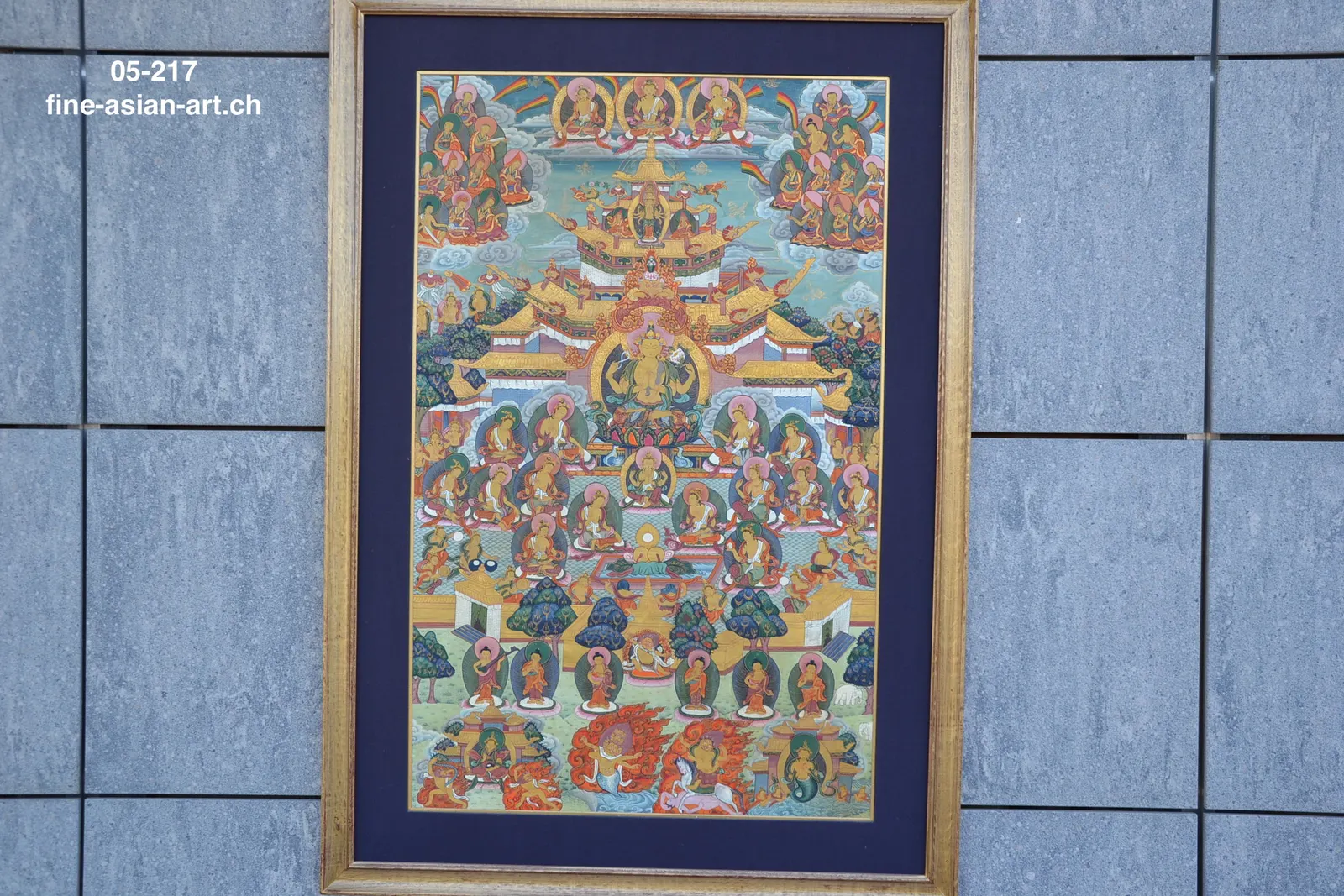
Start in the centre. The central figure is the subject of the painting and is always the largest; its colour, posture (asana), hand gestures (mudra) and attributes identify it. A red Buddha in meditation holding a bowl is typically Amitabha; a figure with a flaming sword is Manjushri; eleven heads and many arms point to a form of Avalokiteshvara.
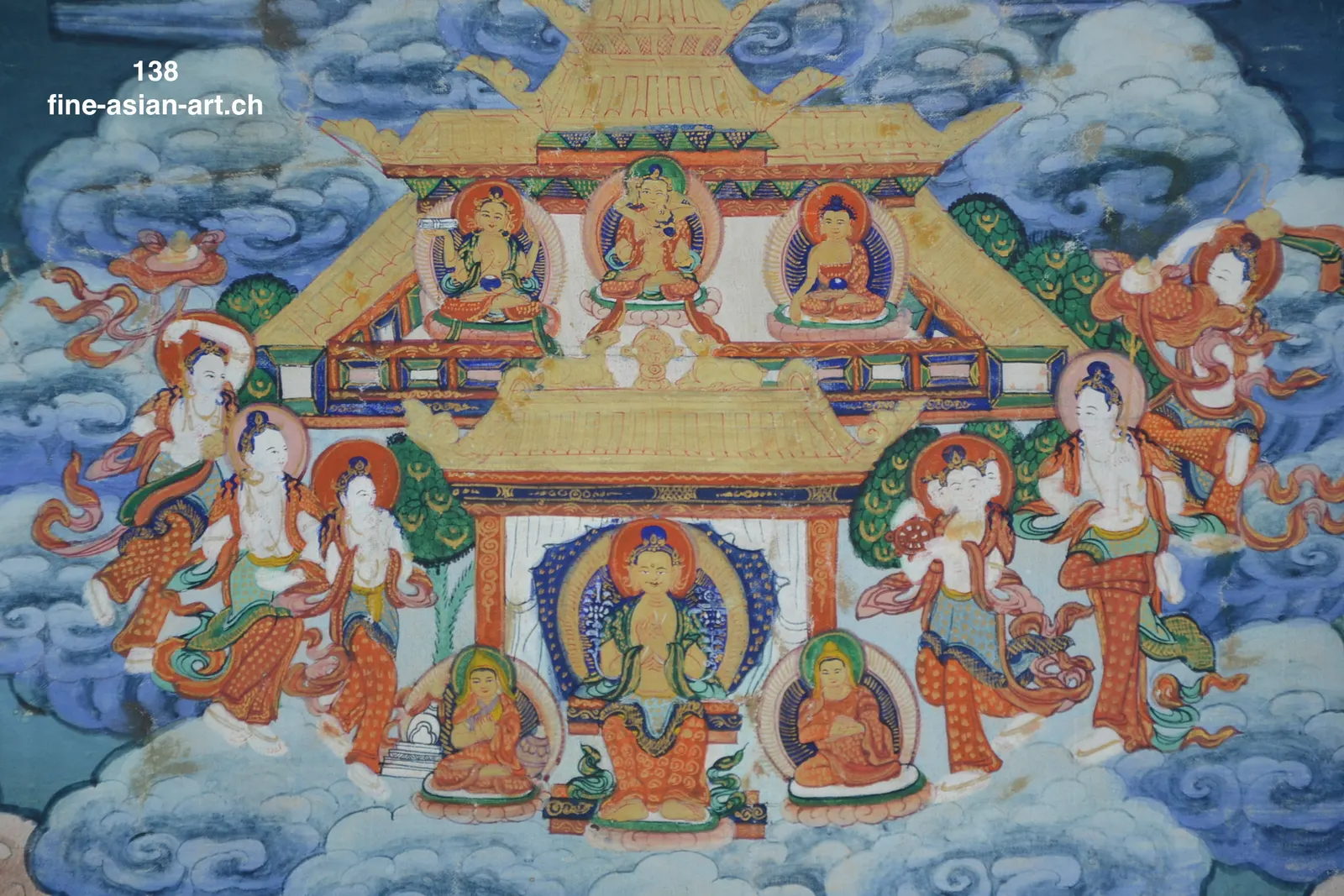
Around the main figure sits its retinue: emanations, attendant deities or disciples, smaller in scale. Along the top you often find lineage figures – the teachers through whom the practice was transmitted – or Buddhas in a heavenly realm. Along the bottom there are usually protectors (dharmapala), wrathful figures in flames, and sometimes the donor or offerings.
The space in between is filled by a stylised landscape of rocks, clouds, water and flowers. Its treatment helps with dating and attribution: deep green-blue landscapes with Chinese-influenced clouds are associated with certain later Tibetan styles, while flat red grounds and dense ornament are more typical of older Newar and central Tibetan painting. Treat such stylistic clues as indications, not proof.
Why are mandalas a type of thangka?
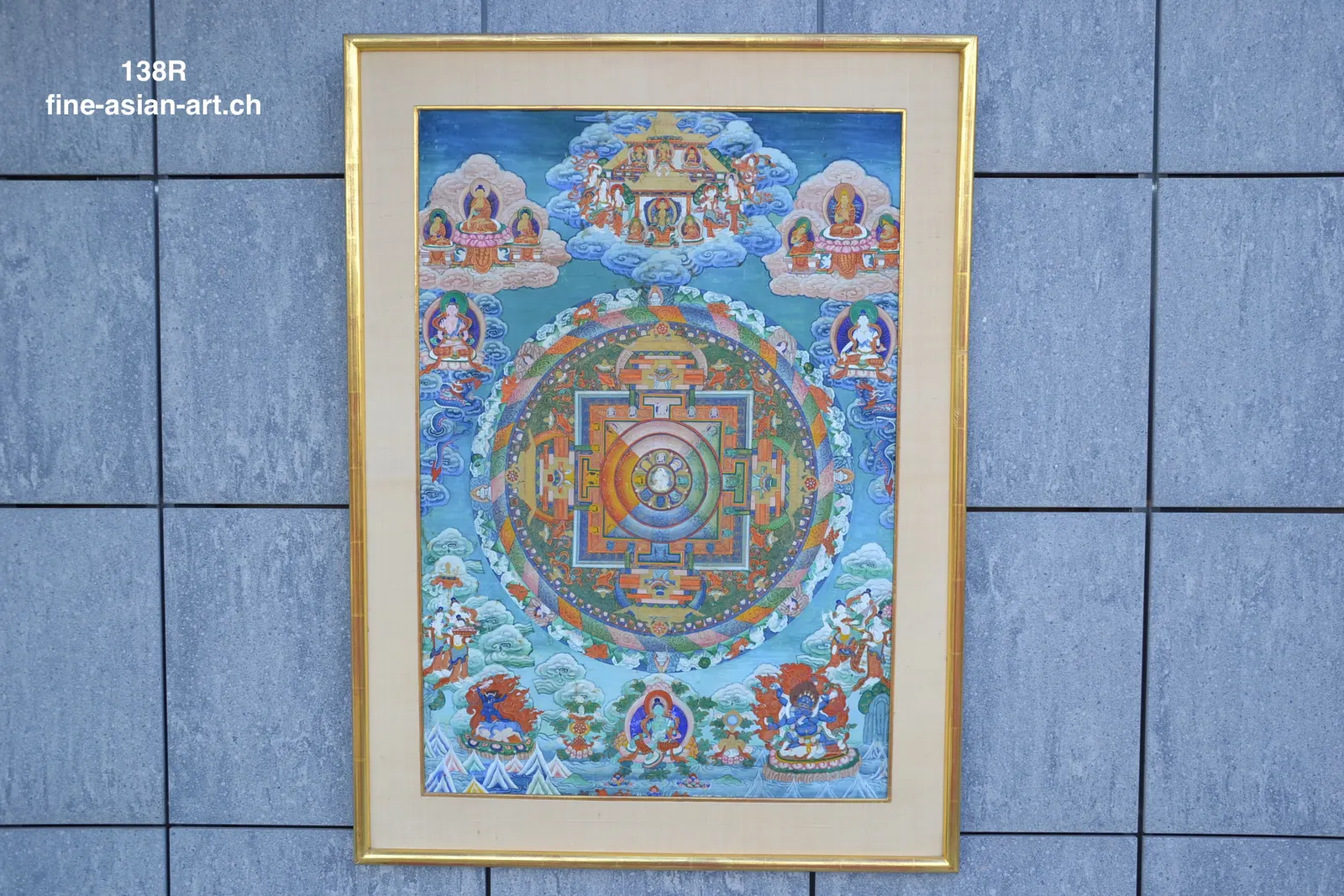
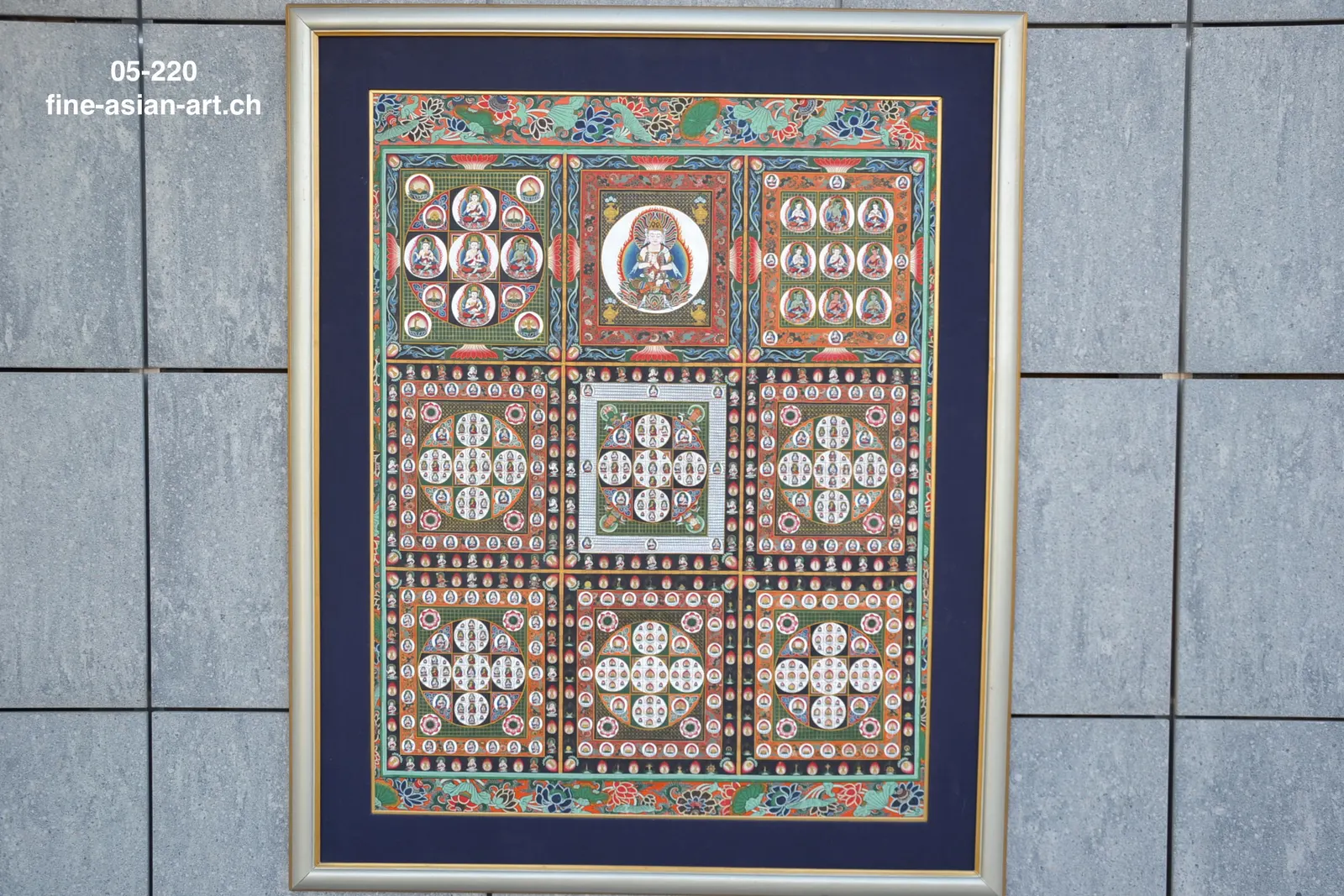
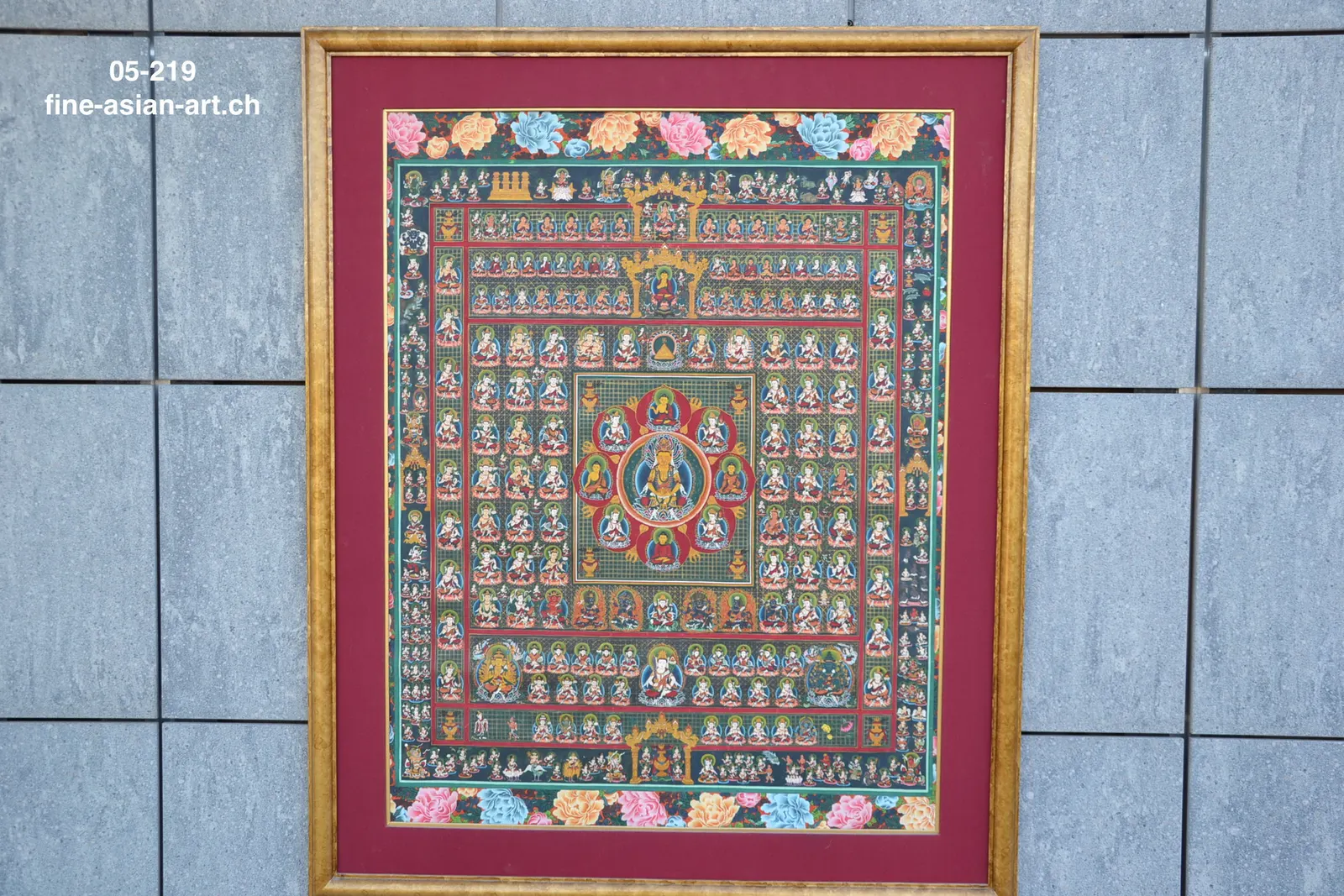
A mandala is a sacred diagram of a deity’s palace seen from above, used as a support for visualisation in tantric practice. Painted on cloth and mounted, it is a thangka like any other. You read it from the outside in: a ring of flames, often a ring of vajras and lotus petals, sometimes the eight charnel grounds, then a square palace with four gates and the main deity at the centre.
The collection includes several mandala thangkas, for example the mandala of Yamantaka (reference 05-209), painted predominantly in gold tones around a square palace, and a large circular mandala of Chakrasamvara (reference M210). Comparing the precision of the geometry and the fineness of the small figures in the gates and corners is one of the quickest ways to judge a painter’s skill.
What are iconometric grids and canonical proportions?
Thangka painters do not draw freely. The figures are laid out according to iconometric rules handed down in canonical texts and workshop tradition: a grid of lines fixes the proportions of each class of figure, measured in units often based on the face or finger width. A Buddha, a peaceful bodhisattva and a wrathful protector each follow a different scheme.
For the buyer this matters because good proportion is visible. On a well-drawn thangka the central figure sits balanced and symmetrical, hands and feet are correctly placed, and the face is calm and even. Distorted anatomy, uneven halos or crowded, careless secondary figures usually indicate a hurried or less trained hand.
Which materials and techniques are used?
Traditionally a cotton or linen cloth, more rarely silk, is stretched on a frame and primed with animal glue and chalk or a similar gesso, then polished smooth. The drawing is done in charcoal and ink, then the colours are applied. Older thangkas use mineral pigments such as malachite, azurite and cinnabar, together with organic colours like indigo and lac; the brushes were traditionally made from animal hair.
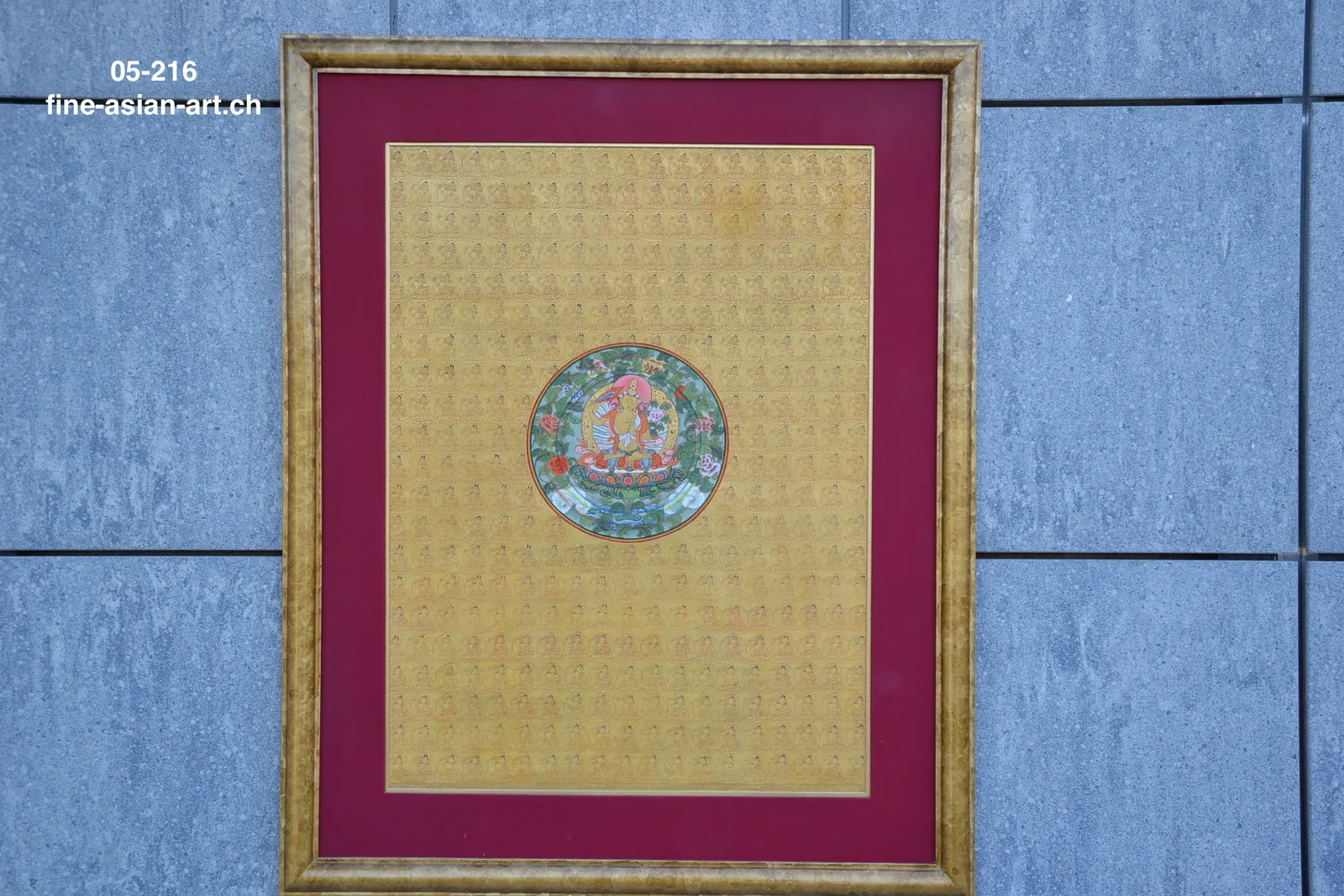
Gold is used for outlines, garments, ornaments and sometimes whole backgrounds; on fine pieces it may be burnished or finely incised. Some thangkas are painted almost entirely in gold with fine red or black line work, as with our Padmasambhava (reference 202). The final and most important step is painting the eyes, often called the “opening of the eyes”, which is said to bring the image to life.
Not every thangka is painted. Appliqué thangkas are assembled from cut pieces of silk and brocade, and some are embroidered or woven; very large appliqué thangkas are displayed at monastery festivals. These require a different eye when evaluating, focused on textile quality and stitching rather than brushwork.
What do the mounting and the back of a thangka tell you?
A traditional mounting frames the painting in silk brocade, often with narrow red and yellow bands said to represent rainbows, a wider lower panel sometimes called the “door”, and a thin silk veil that protects the image when it is not being viewed. Wooden dowels at top and bottom, often with metal or wooden end caps, hold it straight. Mountings are frequently replaced over time, so an old painting in a new mounting is normal and not a fault.
On the back of many consecrated thangkas you find inscriptions: often the syllables om ah hum written behind the forehead, throat and heart of the main figure, or longer mantras and dedications. These are generally associated with consecration (rabne) by a lama. Their presence suggests the thangka was used in practice, but inscriptions alone do not prove age, and their absence does not make a painting less genuine.
How do you evaluate condition, age and quality?
Look closely at the paint layer. Fine craquelure and small losses are common, because a thangka is rolled and unrolled repeatedly. Watch for active flaking, where paint lifts from the ground, abrasion along horizontal fold and roll lines, and darkening from butter-lamp and incense smoke, which gives many temple pieces a brown veil. Water stains and tears in the cloth also affect stability.
Check for overpaint and restoration. Repainted faces, freshly bright patches next to dull areas, or gold that looks too new on an otherwise worn surface can signal later intervention. Raking light and ultraviolet light help, and detail photographs of face, hands and edges are essential if you cannot see a piece in person; we can send additional photos on request.
Be realistic about age. Since the later twentieth century, workshops in Nepal and elsewhere have produced large numbers of thangkas, many of them in a standardised style with synthetic colours, and some artificially aged. Recent thangkas of high quality, painted to canonical rules, exist and are worth having; the point is to judge a painting by its drawing, pigments and execution, and to treat any age statement without scientific testing with appropriate caution.
How should you care for a thangka?
Keep a thangka out of direct sunlight and away from heaters, damp walls and strong swings in humidity, all of which stress the paint and glue layer. If you store it, roll it loosely around a wide tube with the painted side outwards or interleaved with acid-free tissue, never folded or rolled tightly. For flaking paint or serious damage, consult a textile or paintings conservator rather than attempting repairs yourself.
Questions and answers
What is the difference between a thangka and a mandala?
A mandala is a specific subject: a sacred diagram of a deity’s palace. When it is painted on cloth and mounted as a scroll, it is a type of thangka.
Why are the eyes painted last on a thangka?
Painting the eyes, often called the opening of the eyes, is traditionally the final step and is said to bring the image to life. It is often accompanied by ritual and later consecration.
What does om ah hum on the back of a thangka mean?
The syllables om, ah and hum are often written behind the forehead, throat and heart of the main figure and are generally associated with consecration. They suggest ritual use but do not prove age.
How can I tell an old thangka from a recent one?
Look at pigments, gold, drawing quality, the cloth and wear patterns, but be cautious: wear can be faked and good recent work exists. Without scientific testing, age statements remain estimates.
Can a cracked or smoke-darkened thangka still be valuable?
Yes. Fine craquelure and smoke darkening are common on thangkas that were used in practice; active flaking, heavy overpaint and losses to the face matter more.
Written by Fine Asian Art as general background. It is not an appraisal of any individual piece; ask us about a specific object.