How to Identify Buddhas, Bodhisattvas and Deities in Tibetan Art
Figures in Tibetan and Nepalese Buddhist art are identified by a visual code: hand gesture (mudra), posture (asana), the objects they hold, body colour, ornaments and number of heads and arms. Learn a handful of these clues and most statues and thangkas become readable, even when a caption is missing or spelt unusually.
Updated
Where do I start when identifying a figure?
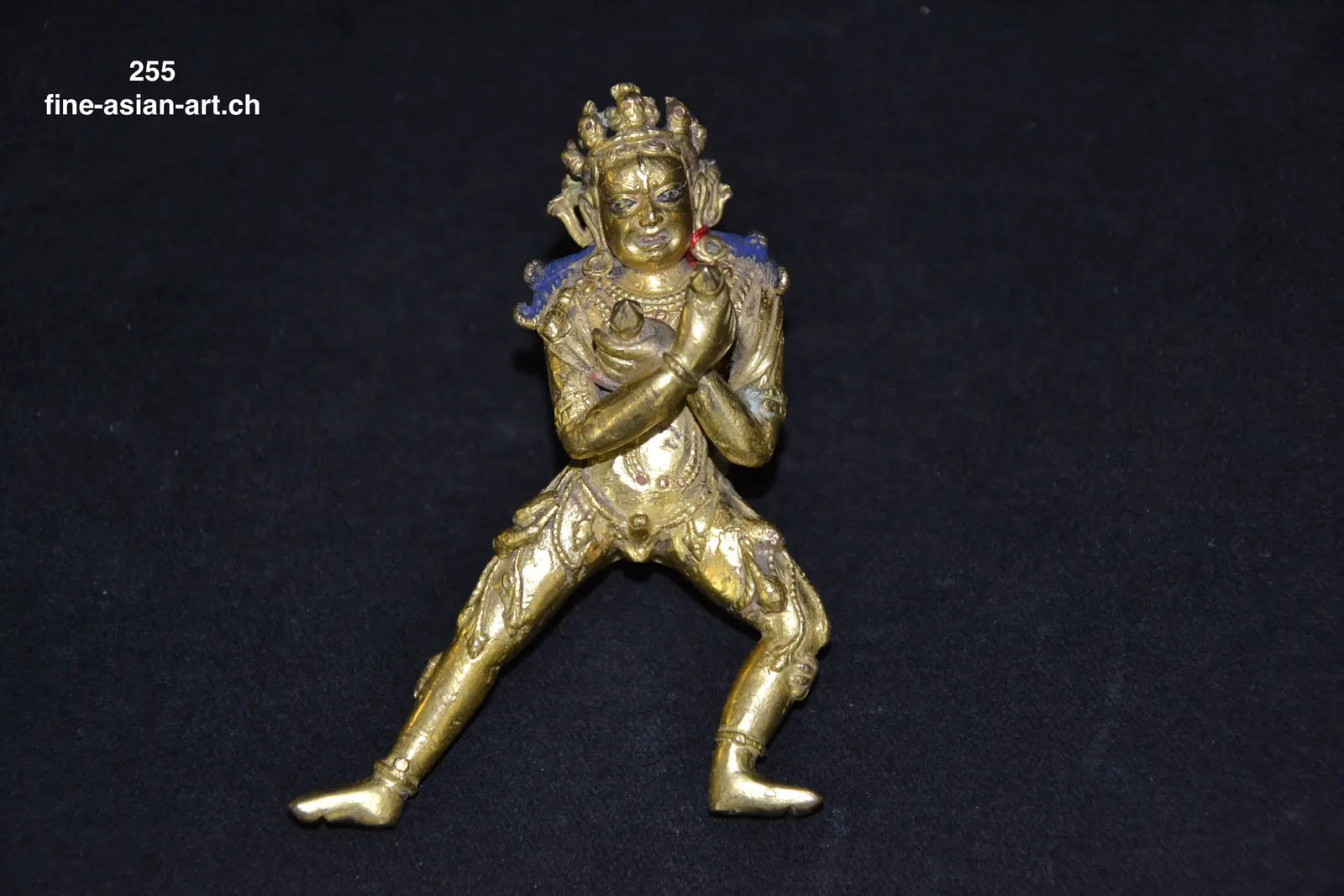
Start with four questions: what are the hands doing, how is the figure sitting or standing, what does it hold, and what colour is the body? The mudra (hand gesture) and the attributes (held objects such as a vajra, bell, sword, lotus or vase) usually narrow the field fastest. Posture (asana) matters too: the cross-legged lotus or vajra posture suggests meditation, while a lunging stance often signals a wrathful protector.
Next, look at dress. Buddhas typically wear a plain monastic robe with no jewellery, whereas bodhisattvas and many deities wear crowns, earrings, necklaces and silk scarves, as befits princely figures. On thangkas, body colour is a strong clue, though on gilt bronzes it is usually lost, so you rely on gesture and attributes. Treat every clue as a probability rather than a rule: iconography differs between schools, regions and periods.
How do I tell the Buddhas apart?
Shakyamuni Buddha, the historical Buddha, is most often shown in the bhumisparsha mudra: the right hand reaches down to touch the earth, calling it to witness his enlightenment, while the left hand rests in the lap, often holding a begging bowl. He has the ushnisha (cranial protuberance), tightly curled hair and long earlobes, and wears a simple robe.
Amitabha, Buddha of Infinite Light, sits with both hands in the meditation gesture (dhyana mudra), often holding an alms bowl, and is red on paintings. Amitayus, the Buddha of Infinite Life, is closely related but is normally shown crowned and jewelled, holding a long-life vase (kalasha) in his lap. The Medicine Buddha (Bhaishajyaguru) is deep blue like lapis lazuli, holds a bowl in the left hand and a sprig of myrobalan (arura) fruit in the right, which extends downwards in a gesture of giving.
The Five Tathagatas (Pancha Buddha) – Vairochana, Akshobhya, Ratnasambhava, Amitabha and Amoghasiddhi – are distinguished by their mudras and, in painting, their colours (commonly white, blue, yellow, red and green). Akshobhya shares Shakyamuni’s earth-touching gesture, so colour and context help separate them.
How do I recognise the main bodhisattvas?
Avalokiteshvara (Tibetan Chenrezig), the bodhisattva of compassion, is perhaps the most frequently depicted. His common four-armed form sits with two hands joined at the heart, often holding a wish-fulfilling jewel, while the outer hands hold a rosary and a lotus. The thousand-armed form (often with eleven heads) shows many arms fanning out like a halo, each palm sometimes bearing an eye.
Manjushri, bodhisattva of wisdom, raises a flaming sword that cuts through ignorance and holds, or has on a lotus at his shoulder, the book of the Prajnaparamita sutra. Vajrapani, bodhisattva of power, is usually shown in a wrathful, dark blue form brandishing a vajra.
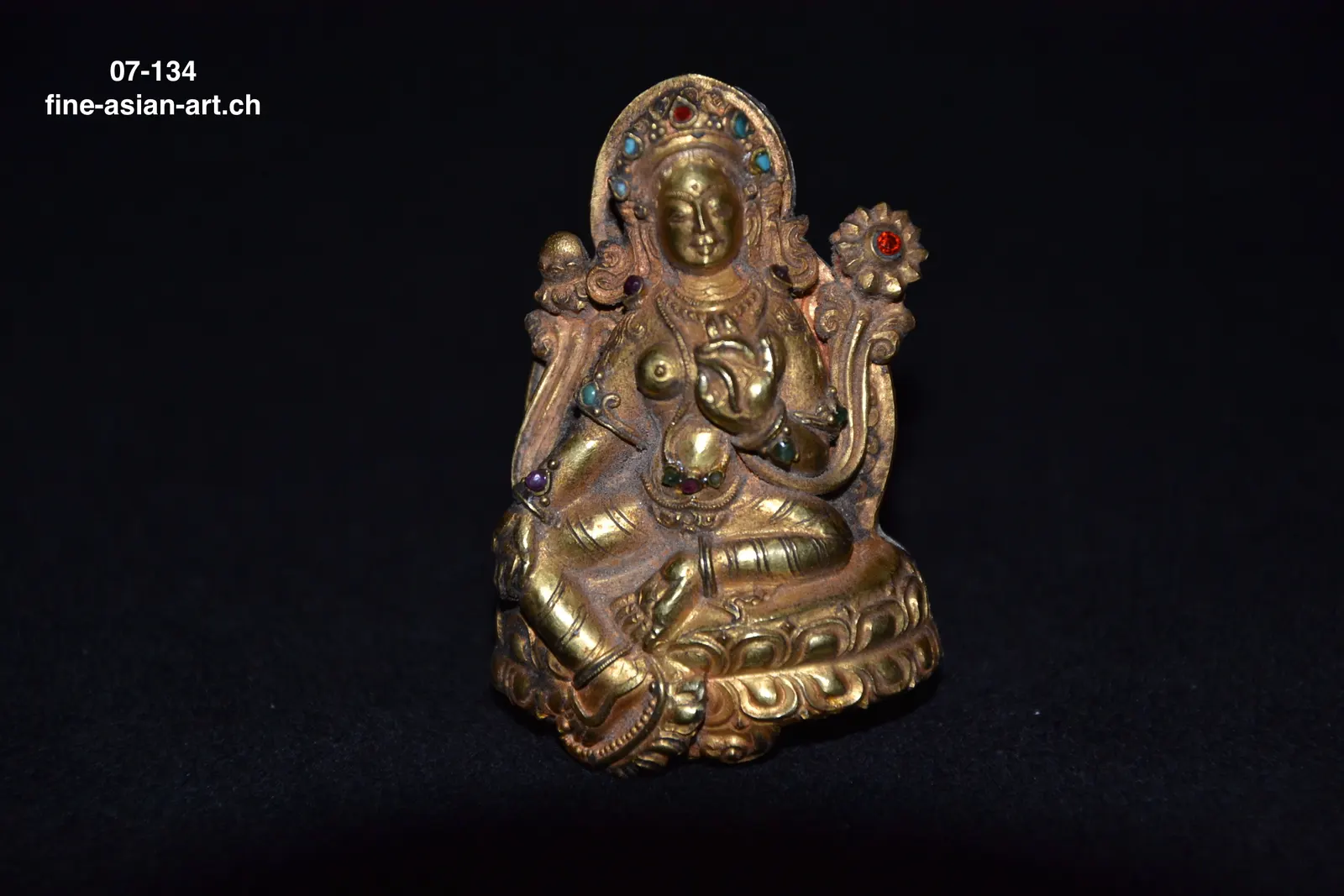
Tara is the great female saviour. Green Tara sits with her right leg extended, ready to step down and help, while White Tara sits in full lotus and is recognised by her seven eyes: one on the forehead and one in each palm and sole. Both typically hold lotus stems at the shoulder.
Who holds a vajra and a bell?
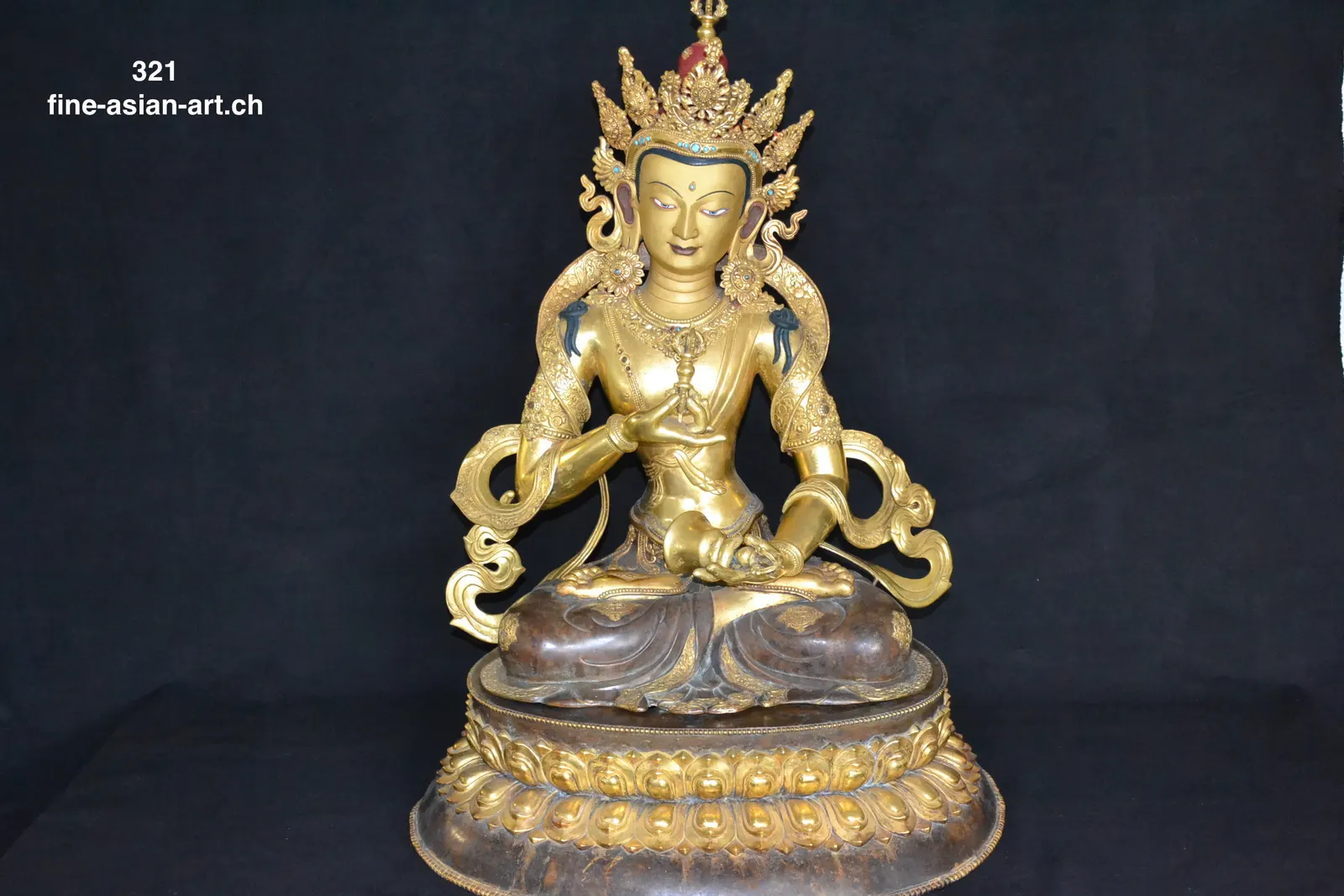
Vajrasattva is the crowned, jewelled figure who holds a vajra (thunderbolt sceptre) at the heart in his right hand and a bell (ghanta) at the hip in his left. He is associated with purification and is usually white in paintings. The vajra and bell are also held crossed at the chest by other tantric figures, such as Vajradhara, so check how they are held.
How do I recognise Padmasambhava and other teachers?
Padmasambhava (Guru Rinpoche), credited in tradition with bringing tantric Buddhism to Tibet, is recognised by his distinctive lotus hat topped with a feather, a moustache, a vajra in his right hand, a skull cup in his left and a trident staff (khatvanga) resting in the crook of his left arm. Other historical teachers and lamas are often shown in monastic robes and hats whose shape can indicate their school, but identification frequently depends on an inscription.
Why do some deities look wrathful, and are they evil?
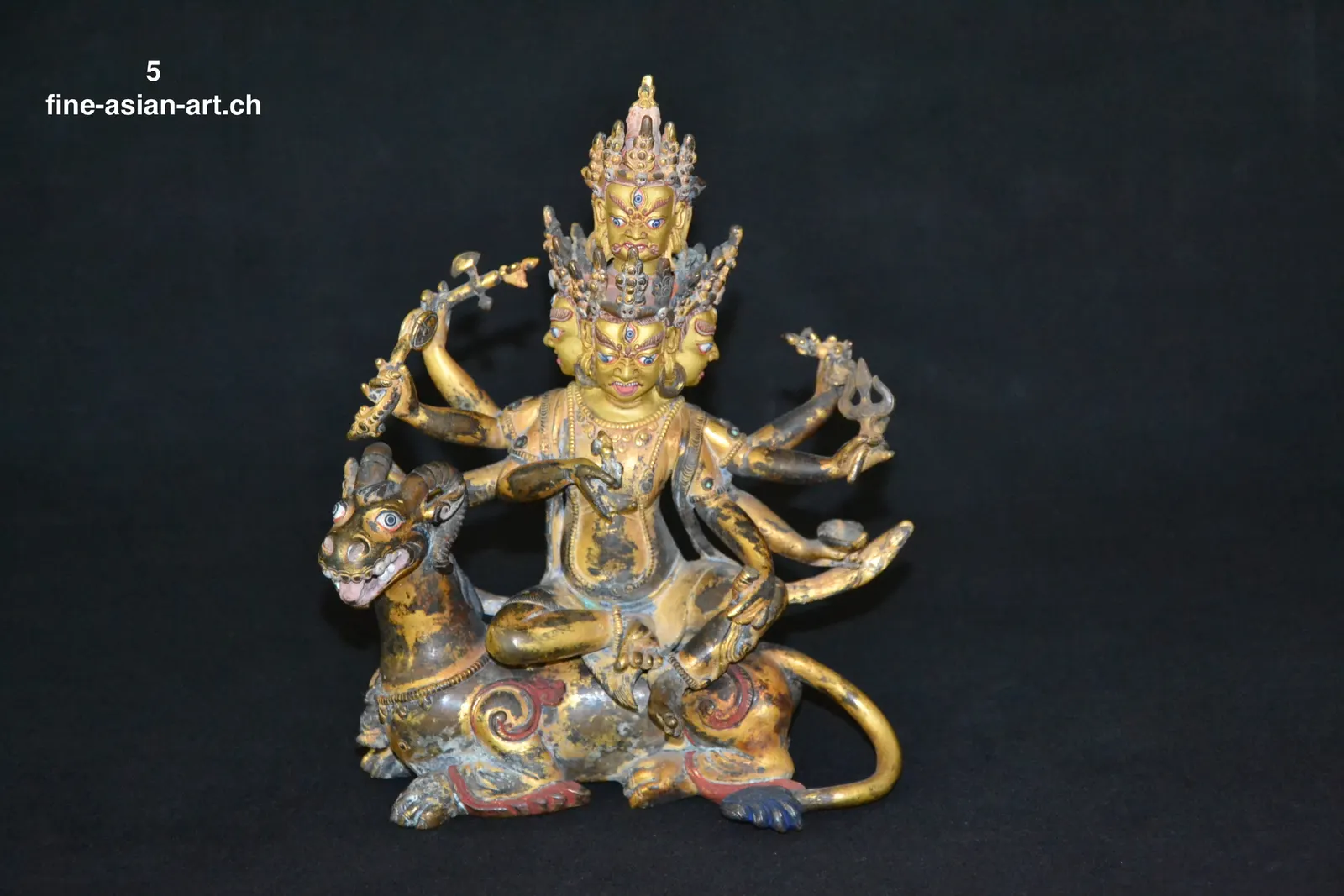
Wrathful does not mean evil. Fierce figures with bulging eyes, fangs, flaming hair, crowns of skulls and trampled figures beneath their feet are understood as protectors or as enlightened energy turned against ignorance, ego and obstacles. Their ferocity is directed at what hinders practice, not at the practitioner.
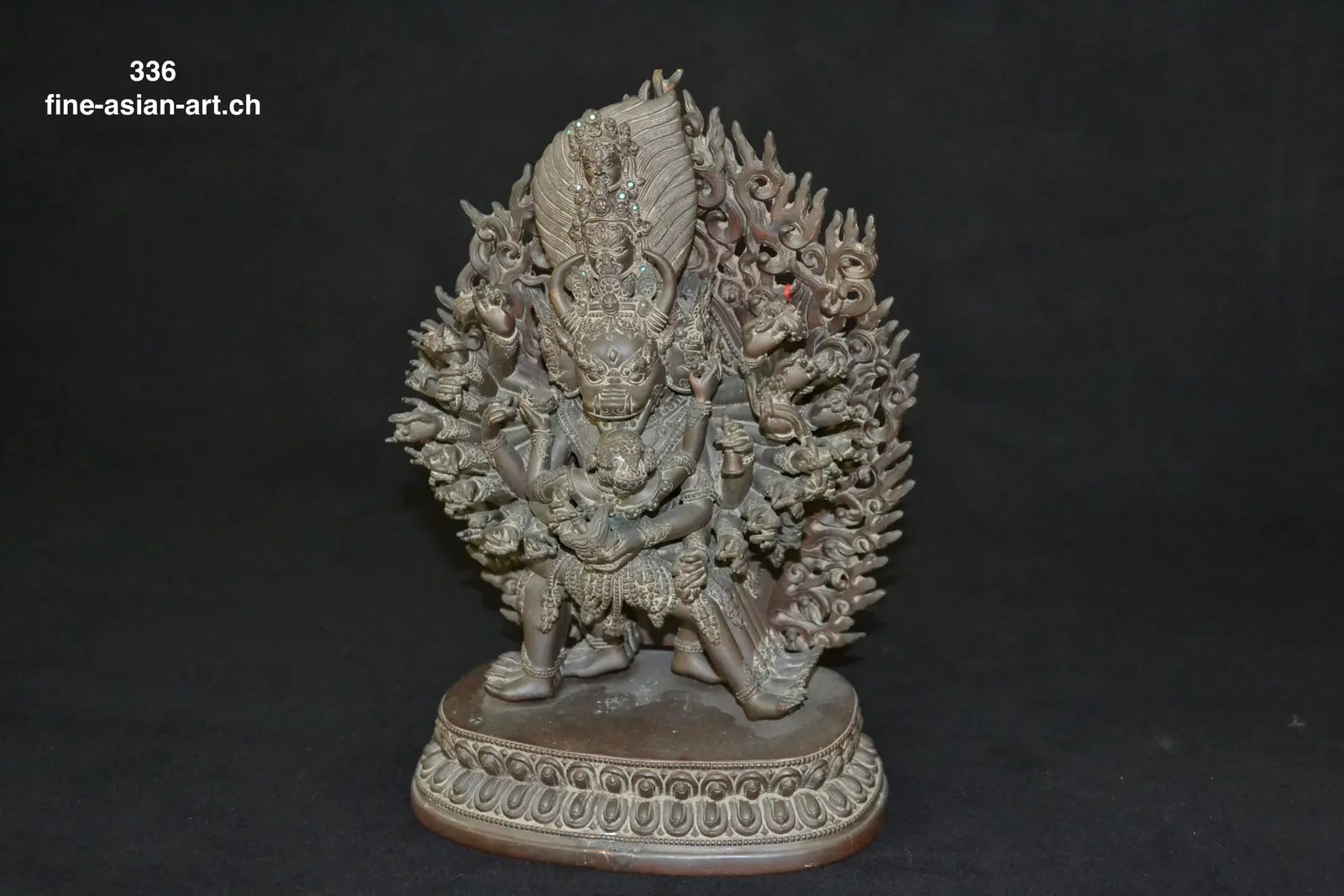
Mahakala, a major protector, is typically dark, stout and holds a chopper and skull cup. Yamantaka, in his form as Vajrabhairava, is recognised by his central buffalo head and many arms and legs. Hayagriva has a small horse head rising from his hair.
Chakrasamvara is a meditational deity (yidam), usually blue, often with four faces and twelve arms, shown embracing his consort Vajravarahi. Such embracing pairs (yab-yum) symbolise the union of compassion or method with wisdom, not a literal or erotic scene in the ordinary sense.
Which figures represent wealth?
Jambhala, often identified or conflated with Kubera, is a pot-bellied figure holding a mongoose that spits jewels, often with a citron or jewel in the other hand. Vasudhara, the female wealth deity, is commonly yellow and in Nepalese art often six-armed, holding ears of grain, a vase and a jewel. Both are associated with abundance in a broad sense, including generosity, rather than simply money.
Why do captions spell the same deity differently?
Names reach us through Sanskrit, Tibetan, Newari and older European transliterations, so spellings vary widely. In our own captions you will find forms such as Chenrasik for Chenrezig/Avalokiteshvara, Bajrasattwo for Vajrasattva and Amitajus for Amitayus. When searching, try the Sanskrit name, the Tibetan name and phonetic variants; if you are unsure what a piece shows, ask us and we can send additional photos on request.
Questions and answers
Which Buddha is touching the earth?
Usually Shakyamuni, the historical Buddha, whose right hand touches the ground in the bhumisparsha mudra to call the earth to witness his enlightenment. Akshobhya, one of the Five Tathagatas, uses the same gesture, so colour and context help.
Why do some figures embrace a consort?
The embracing pair, called yab-yum, symbolises the union of compassion or skilful means with wisdom, which tantric Buddhism regards as necessary for enlightenment. It is a symbolic image, not a depiction of ordinary romance.
How do I tell Amitabha from Amitayus?
Amitabha is generally shown as a monk-like Buddha in a plain robe with an alms bowl in his lap, while Amitayus is crowned and jewelled and holds a long-life vase.
How can I recognise White Tara?
White Tara sits in full lotus posture and has seven eyes: the usual two, one on the forehead, and one on each palm and sole. Green Tara, by contrast, has her right leg extended.
Are wrathful deities demons?
No. In Himalayan Buddhism wrathful figures such as Mahakala or Yamantaka are protectors or enlightened forms whose fierceness is aimed at obstacles and ignorance.
Written by Fine Asian Art as general background. It is not an appraisal of any individual piece; ask us about a specific object.